The Australian holiday shopping season no longer starts on Black Friday. It starts in July.
Amazon Prime Day 2025 ran for seven full days in Australia (July 8-14), from the original 48-hour format launched in 2022. By 2023, Amazon added a second seven-day event in October, creating 14 days of major promotional activity before the traditional November-December peak season begins.
The scale of Amazon’s promotional push is evident in its advertising timeline. This year for the October 7-13 Big Deal Days, Amazon’s campaigns were first detected by Bigdatr on sbs.com.au as early as September 16—nearly a month before the event. The campaign quickly expanded to out-of-home channels and free-to-air television nationally, with heavy digital support intensifying closer to the event date.
This calendar restructuring reflects quantifiable shifts in consumer behaviour and competitive pressure that are reshaping retail economics.
Consumer behaviour is driving the shift
Amazon’s consumer research identified clear demand signals: 90% of Australians report increased price sensitivity due to cost-of-living pressures, with 47% actively tracking prices before purchasing. More significantly, 72% of Christmas gift buyers indicated willingness to shop in July given sufficient discounts[1].
The retail strategy is straightforward: capture spending earlier when consumer budgets are less constrained, before November-December concentrates demand into a compressed window where promotional costs spike across all retailers.
For the November 28 Black Friday period, this creates a timing challenge. Retailers competing primarily on discount intensity in late November are addressing consumers who have already allocated portions of their holiday budgets three months earlier.
Amazon itself starts its Black Friday advertising in early November, with promotions historically running from November 19 through December 2—a two-week window that requires precise timing to capture maximum market share.
Temu’s market disruption: quantified impact
Amazon’s Prime Day expansion also functions as a defensive response to ultra-discount platform growth. Temu captured 20% of Australia’s online-only retail market within 18 months of its March 2023 launch, overtaking eBay’s 17% market share by October 2024[2].
The platform’s economics: $3-4 billion in global advertising spend (2023), products starting at $1-2, and zero minimum purchase requirements for free shipping. This combination produced 1.26-3.8 million monthly Australian shoppers and projected annual sales of $1.3-1.7 billion.
Amazon’s November 2024 response: Haul, a mobile-only storefront with all products under $25 AUD, launched with 60% off across inventory[3]. The strategic calculation is clear—Amazon determined that creating a separate discount marketplace was economically preferable to losing price-sensitive customers or eroding main marketplace margins.
Holiday revenue concentration
The financial stakes are unprecedented. Retailers project 50% of total holiday revenue will concentrate in Click Frenzy, Black Friday, and Cyber Monday combined—the highest percentage recorded. Australian consumers plan average holiday spending of $1,140 per person, representing 14% growth from 2024[4].
This creates a paradox: while total spending increases, the critical revenue window compresses. Major retailers in Australia like Kmart, JB Hi-Fi, and The Iconic compete not just on pricing but on promotional timing and campaign coordination across digital, out-of-home, and television channels simultaneously.
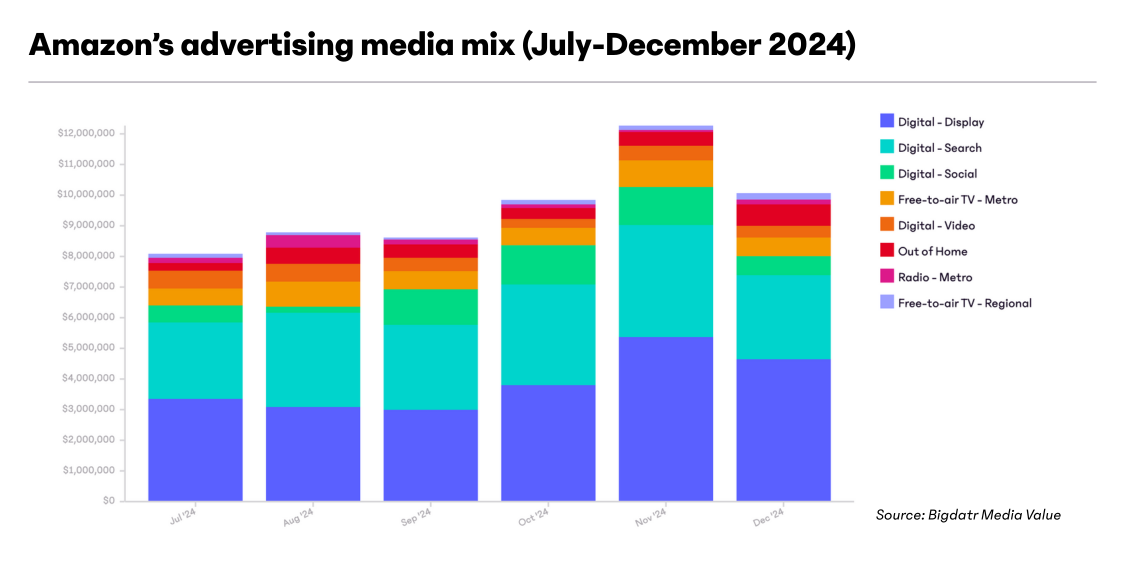
The resource requirements are substantial. Amazon’s Australian media budget runs at or exceeds $8 million per month, with November 2024 recording the highest spend—likely driven by intensified market competition pushing up advertising costs across digital platforms. This level of investment, spread across a sophisticated media mix spanning digital, OOH, and television, establishes a new baseline for competitive visibility.
When Amazon runs seven-day sales with daily themed promotions, coordinated across multiple media channels, the baseline marketing intensity required to maintain visibility rises measurably. Waiting to observe competitor campaigns after launch means operating with incomplete market information during the highest-value selling period.
What this means for retail competitors
Australian retailers face a recalibrated competitive timeline. The traditional Black Friday kickoff has been displaced by mid-year promotional events designed to capture early holiday spending from increasingly price-conscious consumers.
Market share in holiday 2025 will be determined by retailers who recognised the season started in July and adjusted promotional calendars accordingly. For 2026 planning, the strategic question isn’t whether to compete early—it’s how to balance margin protection with the promotional intensity now required to maintain market position across an extended competitive window.
The data is unambiguous: holiday retail strategy must now account for a six-month promotional cycle, not a six-week one.
See what you’re competing against this holiday season.
References
Bigdatr, Advertising Creative and Media Value
[1] https://amazonau.gcs-web.com/news-releases/news-release-details/savvy-shoppers-rejoice-amazon-australias-longest-prime-day-yet?initialSessionID=356-0338117-5596276&ld=ELAUSOA-claude.ai&pageName=AU%3ASD%3ASOA-prime-day-2025
[2] https://www.mi-3.com.au/28-11-2024/temu-takes-20-share-australias-retail-market-share-outpacing-ebay-fonto
[3] https://www.aboutamazon.com.au/news/retail/introducing-amazon-haul-hundreds-of-thousands-of-products-for-less-than-25
[4] https://www.deloitte.com/au/en/about/press-room/from-black-friday-to-boxing-day-optimism-returns-180925.html